


How does clear aligner treatment work?
Clear aligner treatment is carried out by wearing, in sequence, a series of custom aligners made from a digital impression of your teeth. The process begins with an examination by an orthodontist; the steps by which the teeth will move are planned in software, and the aligners are manufactured and handed over to you. You wear each aligner 20–22 hours a day for the period set by the doctor (usually 7–14 days) and then move on to the next one. Checkups take place every 6–10 weeks. When the last aligner is finished, you switch to a retainer to preserve the result. Below you will find each step in detail.
1. Examination: are clear aligners right for you?
At the first appointment, the orthodontist evaluates your teeth, gums, jaw joints and bite (the position of the upper and lower teeth relative to each other). A panoramic X-ray, if needed a cephalometric film (a side X-ray showing the jaw structure) and intraoral photos are taken. At this stage, the following are assessed:
- Cavities, the need for fillings and gum health; if there are active problems, these are treated first
- Whether the problem originates from the teeth or the jawbone
- Whether extraction or IPR (removing a small amount of enamel between the teeth) will be needed
- To what extent your expectations can be met by treatment
At the end of the examination, the doctor tells you whether clear aligners are suitable for you and, if so, the estimated duration and the alternatives. The suitability criteria are explained in detail on the who are clear aligners suitable for page.
2. How is a digital impression taken?
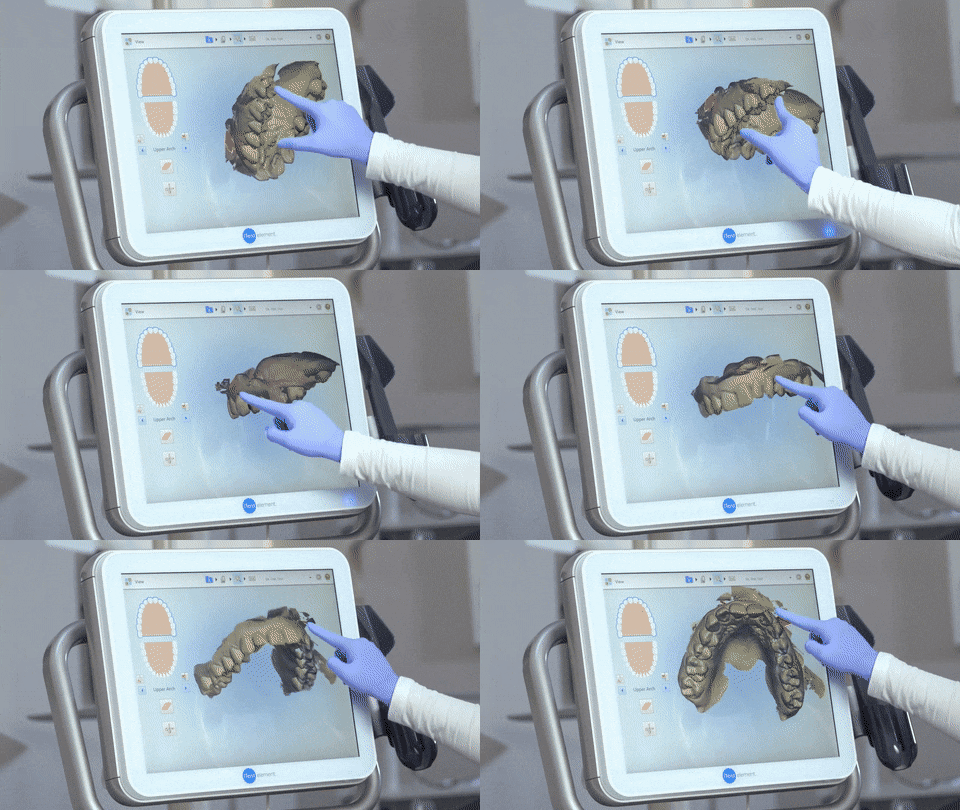
In most clinics, impressions of the teeth are taken with an intraoral scanner. The pen-sized device is moved over the teeth and a three-dimensional digital model is created within a few minutes. The gagging sensation and waiting time of putty impressions are eliminated. In some systems, or in clinics without a scanner, a silicone impression can be taken and scanned in the laboratory; the result is the same. The digital model is transferred to the planning software together with the X-rays and photos.
3. What are digital planning and simulation?
Planning is the most critical stage of treatment. In the planning software, the doctor determines in what order, in which direction and how far each tooth will move. The software divides this movement into steps; each step corresponds to one aligner. When planning is complete, you see the estimated appearance of your teeth at the end of treatment on screen in three dimensions. This simulation is representative; the actual result may vary depending on your wear routine and the biological response of your teeth.
At this stage, the following become clear:
- The total number of aligners and the estimated treatment time
- Which teeth will have attachments (tooth-colored composite bumps)
- Whether IPR is needed and how much
- Whether elastics (rubber bands) are needed
Production does not start until the plan has been approved by the doctor. It is important that you also ask questions about the plan and share your expectations. The treatment fee is also given in writing after this stage, once the number of aligners and any additional procedures are clear; we explain the factors that determine the fee on the clear aligner pricing page.
4. How are the aligners made and when do they arrive?
The approved plan is sent to the manufacturing center. A digital model is produced for each step, a thermoplastic (heat-formed) sheet is pressed over this model to form the aligner, and the edges are trimmed along the gum line and numbered. Invisalign aligners are manufactured abroad, so delivery may take a few weeks. Details of the system are explained on the Invisalign treatment page.
5. What happens when the first aligner is fitted?
When the aligners arrive at the clinic, a delivery appointment is scheduled. At this appointment:
- If attachments are planned, the tooth surfaces are prepared and the attachments are bonded with the help of a template aligner. The procedure usually causes no discomfort, does not require anesthesia and usually takes 20–40 minutes.
- If IPR is planned, a very small amount of enamel is removed between the relevant teeth with fine abrasive strips. This procedure is sometimes spread over later appointments.
- The first aligner is put in and checked for proper fit.
- The technique for putting in and taking out the aligner, use of the chewie (a silicone roll that helps seat the aligner), cleaning and the change schedule are explained.
- You are usually given enough aligners to last until the next checkup.
For putting aligners in and taking them out and for daily wear habits, see the how to use clear aligners page.
6. How do aligner wear and checkups proceed?
Throughout treatment, your responsibility is to wear the aligners 20–22 hours a day and change them at the interval set by the doctor. The change interval is usually 7, 10 or 14 days; the doctor may adjust it depending on how the teeth are moving and how the aligner fits. A feeling of pressure lasting two or three days with each new aligner is normal.
Checkups take place every 6–10 weeks. At the checkup, the doctor:
- Checks whether the teeth are progressing according to plan (whether the aligner fits fully, whether there are gaps)
- Renews attachments or performs IPR if needed
- Hands over the next group of aligners
- Evaluates gum health and hygiene
If the teeth fall behind the plan (if the aligner does not fit), the doctor may have you wear the same aligner longer or update the treatment plan. This is called refinement; it is common in moderate and complex cases and is a natural part of treatment. For refinement, a new digital impression is taken and an additional series of aligners is produced. Problems that may arise at this stage are covered on the clear aligner problems page.
7. How does treatment end, and what is retention?
When the last aligner is completed, the doctor evaluates the result. A short refinement series may be needed for minor adjustments. Once the result is accepted, the attachments are removed without harming the teeth and the surfaces are polished. A retainer is delivered on the same day or within a few days. Until the teeth are stabilized in their new position by bone and connective tissue, they tend to return to their old position; for this reason, the retainer is worn all day for the first months and then at night, and regular long-term wear is recommended. Details are on the retention after clear aligners page.
What you need to do throughout treatment
- Wear the aligners 20–22 hours a day; remove them only for eating, hot drinks and cleaning your teeth
- Change aligners on the schedule set by the doctor, without moving ahead early
- Brush your teeth after every meal and put the aligner back in clean; clean the aligners as described on the how to clean clear aligners page
- Always put the aligner in its case when you take it out
- Do not miss checkup appointments
- Call the clinic without delay if an aligner is lost, cracked or does not fit
How many months treatment takes depends on the difficulty of the case and your wear routine; typical durations are explained on the how long does clear aligner treatment take page. You can find out what you will feel throughout the process on the what it is like to wear clear aligners page. How all these steps will apply to you is determined by your orthodontist after the examination and planning.