

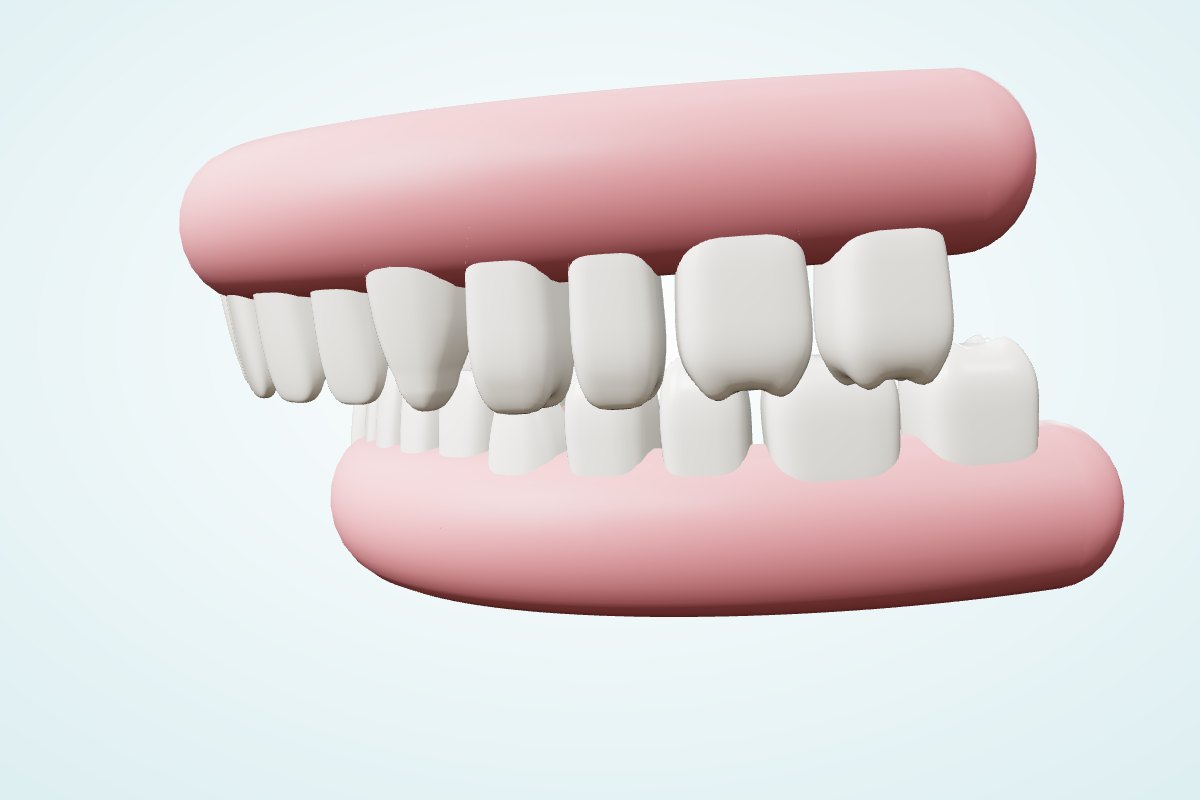
Clear aligners do not fix jaw structure; an aligner is an orthodontic tool that moves the teeth within the jawbone and cannot directly change the size, shape or position of the bone. This is not a shortcoming specific to aligners: brackets also move teeth and do not change bone. Problems that originate in the jawbones are called skeletal discrepancies; a retruded lower jaw, a protruding lower jaw, a narrow upper jaw, open bite with a long face type and jaw asymmetry belong to this group. There are three approaches to these problems. In mild discrepancies, the teeth can be positioned so as to mask the difference in the bone; this is called camouflage treatment and can be done with aligners. In growing children, jaw growth can be guided; some aligner systems serve this function with wings that bring the lower jaw forward. In a patient whose growth is complete, the lasting solution for a marked skeletal problem is orthognathic surgery (surgical repositioning of the jawbones); clear aligners can be used during this process to align the teeth before and after surgery. Which approach is suitable is determined by a clinical examination and a lateral skull X-ray (cephalometric analysis).
What is the difference between a dental problem and a skeletal problem?
In orthodontics, every bite problem is examined by separating it into two components:
- Dental component: The jawbones are in a normal position relative to each other; the problem lies in the alignment or inclination of the teeth. Crowding, gaps between teeth, forward-tipped front teeth and a single tooth in crossbite are examples. This is the area where aligners are at their strongest.
- Skeletal component: The upper or lower jawbone is further forward, further back, narrower, longer or more asymmetric than it should be relative to the skull base and to each other. Because the teeth sit on these bones, the bite problem is a result of the difference in the bone.
In most patients the two components occur together; what matters is how large the skeletal share is. An intraoral examination is not enough to understand this; bone angles are measured on a lateral skull X-ray, profile photographs are evaluated and, if needed, a three-dimensional CT scan is taken. A problem that looks like protruding teeth from the outside may be caused by a retruded lower jaw, and front teeth in reverse bite may be caused by a protruding lower jaw.
What are skeletal discrepancies, and how are they identified?
- Retruded lower jaw (skeletal Class II): The most common type. In profile, the chin looks set back and small, the upper teeth are forward and closing the lips may take effort. It often occurs together with increased overjet and a deep bite.
- Protruding lower jaw or retruded upper jaw (skeletal Class III): The lower front teeth close in front of the upper teeth, and in profile the chin is forward or the midface looks flat.
- Narrow upper jaw (transverse deficiency): The upper jawbone is narrow relative to the lower jaw; this leads to posterior crossbite and crowding.
- Excess vertical growth (long face, skeletal open bite): The face looks long and narrow, the lips close with difficulty and the front teeth do not touch.
- Deficient vertical growth (short face, skeletal deep bite): The lower face is short, the bite is deep and the jaw muscles are strong.
- Asymmetry: The lower jaw is shifted to one side; this is accompanied by a one-sided crossbite and a midline shift.
What can clear aligners do for skeletal problems?
Although aligners do not change bone, they play a role in skeletal problems in three ways:
Camouflage treatment
In a mild skeletal discrepancy, the teeth are moved so as to compensate for the difference in the bone. For example, if the lower jaw is slightly retruded, the upper front teeth are moved back (with IPR, distalization or, if needed, extractions) and the lower teeth are brought forward with Class II elastics; as a result the teeth close properly, but the position of the jaw stays the same. Similarly, in a mild Class III case, the upper teeth are tipped forward and the lower teeth backward. The limit of camouflage is how far the teeth can move within the bone and what is expected of the profile; teeth cannot be moved outside the bone, otherwise gum recession and root problems occur. Camouflage does not noticeably change the facial profile.
Guiding the jaw during growth (mandibular advancement)
For many years, functional appliances (appliances that guide growth by holding the lower jaw forward) have been used for a retruded lower jaw in children and adolescents. In some clear aligner systems, the same principle is applied with plastic wings on the sides of the upper and lower aligners: when the mouth closes, the wings meet and position the lower jaw forward. The teeth are aligned at the same time. The effect is expected while the appliance is worn and during the growth spurt (usually ages 10–12 in girls and 12–14 in boys); scientific studies show that a significant part of the effect is dental and that the skeletal contribution may be limited but present. For a narrow upper jaw, an expansion appliance is still the first choice; aligners come into play after expansion.
Orthodontics combined with surgery
For a marked skeletal discrepancy, the lasting solution is orthognathic surgery. In this process, orthodontics consists of three stages: bringing the teeth into the correct position on the bone before surgery (decompensation), the surgery itself, and fine-tuning after surgery. In suitable cases, clear aligners can be used in place of brackets in these stages; additional devices are needed to stabilize the jaws during surgery. The surgical plan is a joint decision of the oral and maxillofacial surgeon and the orthodontist.
In which situations are aligners definitely not enough?
- An adult with a marked retruded or protruding lower jaw: If the bone discrepancy exceeds a few millimeters, camouflage is either not possible or does not meet expectations for the profile. The surgical option is discussed.
- A narrow upper jaw at the bone level: In children, a rapid maxillary expander is needed; in adults, miniscrew-assisted (MARPE) or surgically assisted (SARPE) expansion is needed.
- Skeletal open bite: In a long face type, even if tooth movement alone brings the front teeth together, the risk of relapse is high; surgery or miniscrew-assisted intrusion is evaluated.
- Marked asymmetry: A shift of the jaw midline from the facial axis cannot be corrected with tooth movement.
- Airway problems: In a retruded lower jaw associated with sleep apnea, surgery is evaluated in terms of both the bite and breathing.
These situations do not rule out aligners entirely; aligning the teeth before and after surgery, or after expansion, can be done with aligners. The fact that aligners alone are not sufficient should be shared openly before treatment. For related problems, see our protruding teeth, crossbite and open bite pages.
How long does treatment take for skeletal problems?
- Mild skeletal component, camouflage with aligners: About 14–24 months.
- Mandibular advancement during growth: 6–12 months of guidance, followed by 10–14 months of tooth alignment; 18–24 months in total.
- Aligners after an expansion appliance: 4–6 months with the appliance, followed by 12–18 months with aligners.
- Orthodontics combined with surgery: 6–18 months before surgery, healing, and 4–8 months after surgery; 18–30 months in total.
These ranges are general; wearing the aligners 20–22 hours a day, consistent use of elastics and appliances, and keeping up with check-ups every 6–10 weeks affect the duration. For details, see our treatment duration page.
What is the difference between children and adults?
In skeletal problems, age is more decisive than in any other problem. In children and adolescents, because the jaws are still growing, it is possible to guide growth: a narrow upper jaw can be widened, a retruded lower jaw can be guided forward with a functional appliance or aligners with a mandibular advancement feature, and in a protruding lower jaw the upper jaw can be brought forward with a face mask. For this reason, an orthodontic check-up at around age 7 is important for catching skeletal problems early. Early treatment does not always prevent surgery, but it can reduce the size of the problem. In adults, because growth is complete, two options remain: camouflage in a mild case, and surgery in a marked case. Camouflage does not change the profile; surgery changes both the bite and facial proportions but involves an operation and a recovery period. Which approach is chosen depends as much on the patient's expectations as on the medical findings, and it is discussed together at the examination. For information by age, see our at what age can you get clear aligners page.
How is retention carried out after skeletal treatments?
- After camouflage: Because the teeth have been positioned close to the boundary of the bone, the tendency to relapse is high; a fixed retainer together with a removable retainer worn at night for life is recommended.
- After mandibular advancement: The bite is monitored until growth is complete; the retainer continues to be worn at night and, if needed, a retainer that holds the lower jaw forward is designed.
- After expansion: Because the arch tends to narrow, a retainer covering the palate is used for a long period.
- After surgery: While the bone is healing, retainers and elastics are worn according to the schedule set by the dentist; afterward, standard lifelong night-time wear begins.
Retention is explained in detail on our retainer after treatment page, and the general criteria for aligner suitability on our who are clear aligners for page.