


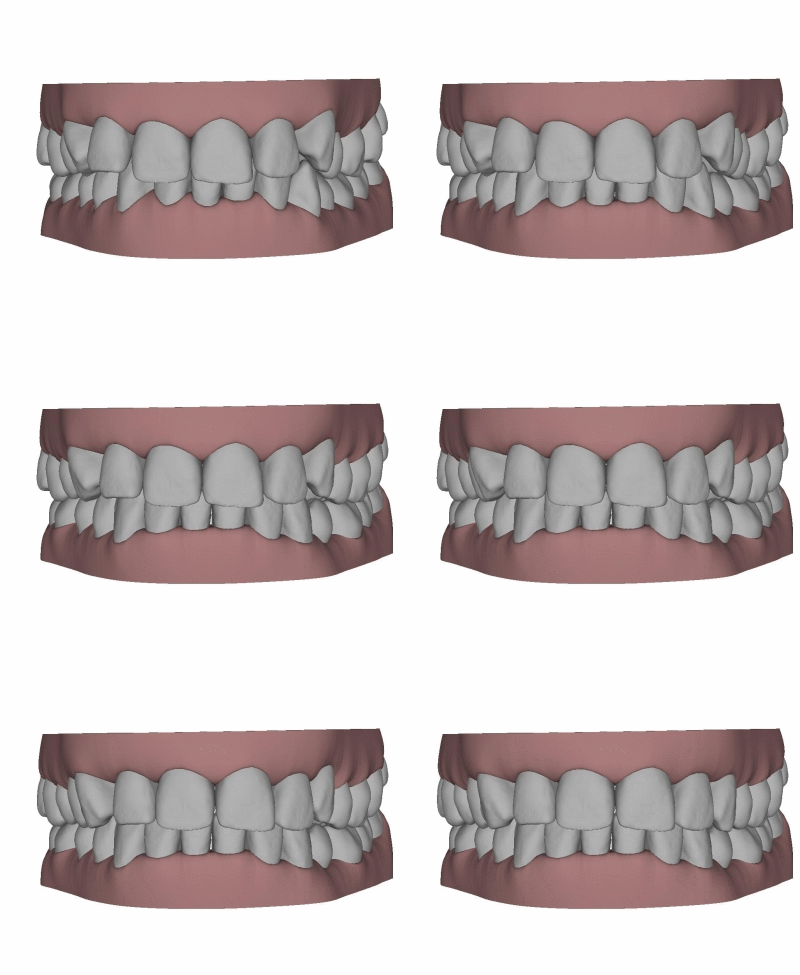
How do teeth change before and after clear aligners?
The difference between before and after clear aligner treatment is that the teeth line up along a smooth arch, gaps close, and the upper and lower teeth bite together harmoniously. The change does not happen all at once; it progresses 0.2–0.3 millimeters with each aligner. In the first weeks no difference is visible; for most people the first noticeable improvement in the front teeth appears in month 2–3, and the result is completed within 6–24 months depending on the case. On this page we illustrate the order in which the change progresses for common problems.
Why don't we publish patient photos?
Healthcare advertising regulations in Türkiye do not allow publishing before-and-after photos of patients. This rule protects patients' privacy and prevents treatment results from being presented in a misleading way. For this reason, there are no real patient images on this page or anywhere on the site. Instead, we use illustrations, animations and explanatory text. It is useful to know that before-and-after patient photos you see on any website or social media are subject to the same regulations.
If you are curious about how your own teeth could look at the end of treatment, the way to see it is a simulation prepared from a digital scan taken in the clinic; we explain it below.
What is a digital simulation, and what does it show?
At the consultation, a three-dimensional digital scan of your teeth is taken. In the planning software, the orthodontist determines in which order and how far each tooth will move. The software shows the step-by-step change of the teeth on screen from the start to the end of treatment: this is the projected result for your teeth. Depending on the system used, clinics call this simulation by different names; the function is the same.
In the simulation you will see:
- The current state of your teeth (before)
- The position of the teeth at each aligner stage
- The target alignment and bite at the end of treatment (after)
- Which teeth will get attachments (tooth-colored composite bumps) and the areas where IPR (removing a small amount of enamel between teeth) will be done
The simulation is a target, not a promise. Depending on the biological response of your teeth and on wearing the aligners 20–22 hours a day, the actual result comes close to the simulation; small differences are corrected with a refinement series. We explain how planning is done on the how clear aligner treatment works page.
How does the change progress with crowded teeth?
With crowding, teeth overlap, rotate or move in and out of the arch because of lack of space. Illustratively, the change progresses in this order:
- Before: The lower front teeth overlap each other, one or two teeth stick out or sit inward, and the dental arch is irregular.
- First months: The dental arch widens slightly and, if needed, space is created with IPR. The teeth sticking out start to be drawn into the arch.
- Middle phase: Overlapping decreases and the teeth begin to line up side by side. Rotated teeth slowly turn; this is one of the longest movements.
- Final phase: The teeth align on a smooth arch and the edges come to the same level. A refinement series may be used for fine-tuning.
- After: Neatly aligned front teeth and a harmonious look along the gum line.
Details by degree of crowding are on the clear aligners for crowded teeth page.
How does the change progress with gaps (diastema)?
- Before: A noticeable gap between the two upper front teeth, sometimes small spaces between the side teeth as well.
- First months: The aligners push the teeth toward each other; the gap visibly begins to narrow. Gap closure is noticed earlier than the correction of crowding.
- Middle phase: The main gap largely closes; the other teeth are also moved in a balanced way so the space does not collect in one spot.
- After: The teeth are in contact, with a front view free of gaps. The relationship between the gums and the lip does not change; in some cases the lip tie (frenulum) may need to be evaluated.
Because gaps tend strongly to reopen, retention is especially important; see clear aligners for gaps between teeth.
How does the change progress with bite problems?
- Deep bite: The upper front teeth cover the lower front teeth too much. In treatment, the front teeth are brought slightly more upright and balanced with the back teeth. The change is more noticeable from the side; from the front it shows as more of the lower teeth being visible. See clear aligners for deep bite.
- Open bite: The front teeth do not touch when the mouth is closed. In treatment, the front teeth are brought closer together and the back teeth are controlled. Tongue habits affect the change. See clear aligners for open bite.
- Crossbite: One or more upper teeth sit inside the lower teeth. In treatment, these teeth are moved outward and the opposing teeth inward if needed. See clear aligners for crossbite.
- Protruding teeth: The upper front teeth are tilted forward. Space is created and the teeth are moved back; the change in profile is noticeable from the side. See clear aligners for protruding teeth.
The part of bite problems that comes from the jawbone cannot be corrected with clear aligners; we explain the limits on the can clear aligners correct jaw structure page.
How does the visibility of the change progress over time?
| Period | What happens to the teeth | Noticeable in the mirror? |
|---|---|---|
| 0–4 weeks | Teeth move less than a millimeter with the first aligners; a feeling of pressure is present | No |
| 1–2 months | The dental arch widens slightly, space is created with IPR if needed, and teeth outside the arch move toward it | Very slightly, when comparing photos |
| 2–4 months | Overlapping of the front teeth decreases and gaps narrow noticeably | Yes, in the front teeth |
| 4–8 months | Rotated teeth turn into place and the bite takes shape; mild cases reach the finishing stage | Yes, clearly |
| 8–18 months | In moderate and complex cases, the main correction is completed and fine-tuning begins | Yes, by others as well |
| Final stage | Refinement series, settling of the bite, removal of attachments | Final appearance |
| After treatment | Maintaining the result with a retainer | Maintained; teeth shift back if the retainer is abandoned |
Timeframes vary depending on the case and wear habits. This is an illustrative description; your plan is set after your examination and digital planning.
The durations in the table are general trends; when the change becomes visible in your case depends on the number of aligners and how consistently you wear them. Details on duration are on the how long does clear aligner treatment take page.
How are the face and smile affected?
Clear aligners move the teeth; they do not change the shape of the jawbone. Even so, aligning the teeth directly affects the smile: the teeth come to the same level, gaps close, and the arrangement of the teeth visible when smiling improves. When protruding teeth are moved back, lip support can change and the profile may look slightly different from the side. A marked change in face shape should not be expected; claims to that effect are not realistic. Treatment also does not change gum color, tooth color or tooth shape; these are separate treatment topics.
Keeping the result: retention
The appearance achieved at the end of treatment will not last unless the retainer is worn regularly. Until the teeth are stabilized in their new position by bone and connective tissue, they tend to move back to where they were; this tendency is especially marked in cases of gaps and rotated teeth. The retainer is worn all day in the first months, then at night, and regular long-term use is recommended. Details are on the retention after clear aligners page.
How can you see your own before-and-after projection?
The only reliable way to see how your teeth could look at the end of treatment is the simulation prepared after an orthodontic examination and a digital scan. At the consultation, you will be told whether your teeth are suitable for clear aligners, the estimated duration and the result that can be achieved. You can find what to expect during treatment on the living with clear aligners page.