

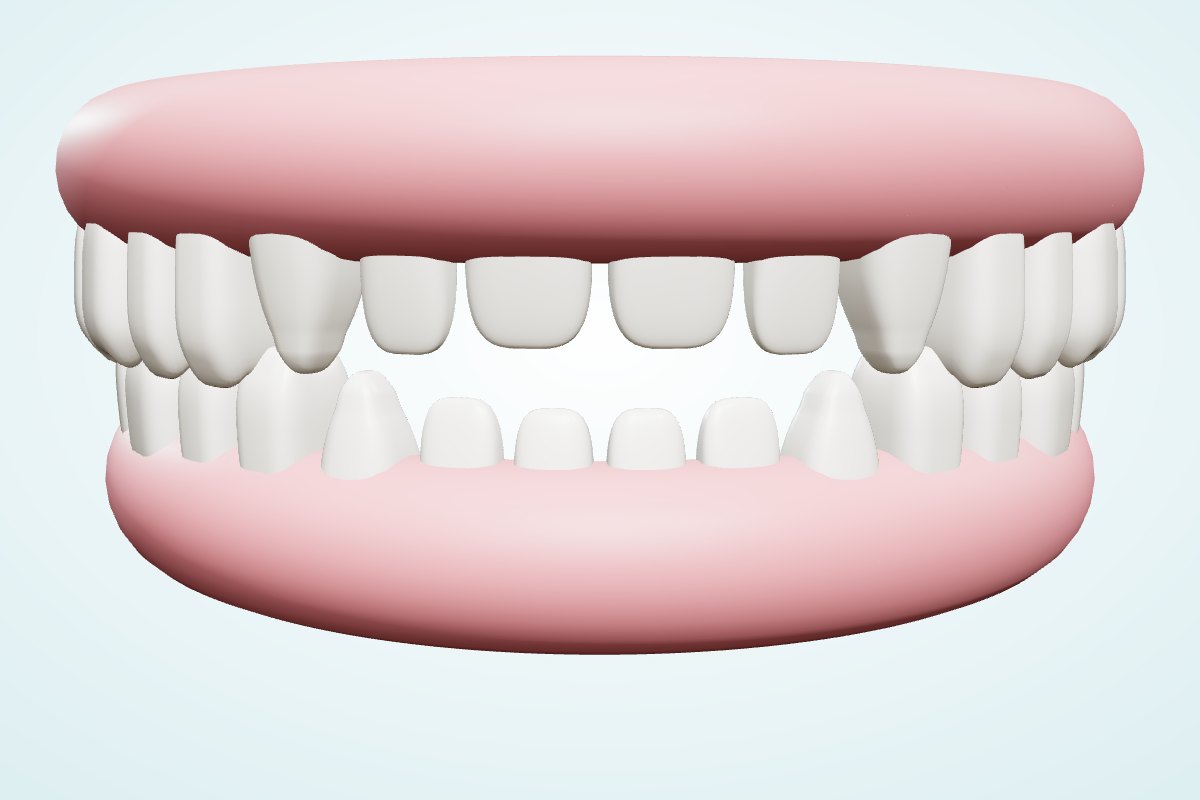
An open bite (when the upper and lower front teeth do not touch as the teeth are closed, leaving a vertical gap between them) can be corrected with clear aligners in most patients if it is dental in origin. Aligners create contact in the front by gently pressing the back teeth into the bone (intrusion) and moving the front teeth vertically to lengthen them (extrusion); because the aligner covers the back teeth all day, it naturally supports this movement. For this reason, some studies regard open bite as a problem where clear aligners may be more favorable than brackets. However, if the open bite stems from the vertical growth pattern of the jawbone (skeletal open bite), aligners alone are not enough; growth-guiding appliances may be considered for a growing child, and orthognathic surgery for an adult. Which type it is gets determined by a clinical examination and a lateral jaw X-ray.
What is an open bite and how is it recognized?
In a normal bite, the upper front teeth overlap the lower front teeth by about 2–3 mm. With an open bite, the back teeth touch while a vertical gap remains between the front teeth; the tongue may be visible through this gap. In the less common lateral (posterior) open bite, the gap is in the molar region. Signs include:
- Difficulty biting with the front teeth; being unable to bite through foods such as sandwiches or lettuce leaves with the front teeth.
- Difficulty pronouncing certain sounds (especially s, z, t, d) or a lisp.
- Lips that cannot close without strain, with the mouth staying slightly open at rest.
- A long, narrow facial appearance (in the skeletal type).
In the clinic, the amount of open bite is measured in millimeters. A lateral jaw X-ray (cephalometric radiograph) is used to evaluate the vertical angles of the jawbones and decide whether the problem is dental or skeletal. This distinction directly determines the treatment plan.
What causes an open bite?
- Prolonged thumb sucking or pacifier use: Habits that continue beyond age 3–4 in childhood prevent the front teeth from erupting fully.
- Tongue thrust (incorrect swallowing): When the tongue pushes between the front teeth during swallowing, it keeps the teeth constantly apart. In adults, it is the main cause of relapse.
- Mouth breathing: Enlarged tonsils or adenoids, chronic allergies and similar causes keep the mouth open; the jaw grows excessively in the vertical direction.
- Skeletal growth pattern: An inherited tendency for the lower jaw to grow by rotating downward and backward.
- Jaw joint changes: Rarely, bone resorption at the head of the joint can lead to an open bite later in life.
- Over-eruption of the back teeth: If the molars have grown too long, the front teeth cannot close.
How do clear aligners correct an open bite?
In open bite treatment with aligners, the goal is to gently intrude the back teeth and bring the front teeth together. The main mechanisms are:
Intrusion of the back teeth
The aligner covers the back teeth all day with a thin layer of plastic. As the chewing muscles press on this layer, the back teeth are pushed very slightly into the bone. Even a movement of a few millimeters allows the lower jaw to rotate forward and upward and the front teeth to close. Unlike brackets, this is an advantage that aligners provide by their very nature.
Extrusion of the front teeth
The front teeth are moved downward out of the jawbone in a planned way. Because this movement is difficult for aligners, attachments (tooth-colored composite bumps) are bonded to the teeth; the aligner grips these bumps to pull the tooth. Some systems use specially optimized attachment shapes.
Elastics
Small rubber bands may be worn vertically between the upper and lower aligners to bring the front teeth closer together. They are hooked onto attachments or small cutouts in the aligner and worn for a prescribed number of hours each day.
Retracting the front teeth
Tipping forward-flared front teeth back brings the tips of the teeth closer together and partially closes the open bite. For this reason, space is created in some cases with IPR (fine interproximal reduction between the teeth).
When are clear aligners alone not enough?
- Skeletal open bite: If the vertical angle of the jawbone is markedly increased and the face is long, tooth movement does not solve the problem; it only masks it. In a patient who has finished growing, orthodontics is planned together with orthognathic surgery (surgical repositioning of the jawbone) for a lasting solution. In this process, the alignment of the teeth before and after surgery can be done with clear aligners.
- Skeletal open bite in a growing patient: Appliances that control vertical growth (bite blocks, high-pull headgear, special functional appliances) and habit-breaking appliances are used. In some cases these can be combined with aligners.
- Cases requiring a large amount of intrusion: If the back teeth need to be intruded by more than 3 mm, aligners are limited; they can be supported by mini-screws placed in the gum (temporary anchorage devices).
- An ongoing habit: If tongue thrusting or thumb sucking continues, no mechanical treatment will be lasting. Tongue exercises (myofunctional therapy) or a habit-breaking appliance are added to the treatment.
- Airway problems: If there are enlarged adenoids, tonsils or allergic congestion, an ear, nose and throat evaluation is recommended.
You can read more about the role of clear aligners and brackets in this problem on the clear aligners or braces page, and about skeletal limits on the can aligners correct jaw structure page.
How long does clear aligner treatment take for an open bite?
Because an open bite requires vertical movement, it may take somewhat longer than an average aligner treatment:
- Mild dental open bite (1–2 mm): About 9–14 months.
- Moderate dental open bite (3–4 mm): About 14–20 months.
- Cases with a skeletal component or surgery: 18–30 months; the surgical schedule determines the duration.
Consistent use of elastics, wearing the aligners 20–22 hours a day and not missing checkups every 6–10 weeks directly affect the duration. For general information, see the treatment duration page.
Is open bite treatment different in children and adults?
In children, the priority is breaking the habit. If thumb sucking or pacifier use stops by age 4, the open bite often closes on its own. Simple reminder appliances can be used for persistent habits. During growth, vertical growth can be guided; a skeletal open bite treated in this period may reduce the need for surgery in adulthood. Aligner systems designed for the mixed dentition stage can be used in mild cases. In adults, because growth has ended, a skeletal problem can only be corrected surgically; for a dental open bite, however, aligners are a suitable and effective option. In adults, an evaluation of tongue-thrust habits and a jaw joint examination are added to the treatment. For information by age group, see the clear aligners by age page.
Does an open bite come back after treatment?
Open bite is known as one of the problems with the highest relapse rates in orthodontics. For lasting results:
- Retainer: A removable clear retainer is often preferred for open bite because it also covers the back teeth; it is worn for long hours in the first months and then at night for life. A fixed wire can also be added to the front teeth.
- Correcting the tongue habit: Myofunctional exercises and, if needed, speech therapy are the most effective way to prevent relapse.
- Keeping the airway open: If mouth breathing continues, it should be treated.
- Regular checkups: Contact between the front teeth is monitored regularly for the first two years after treatment.
For details on retention, see the retainer after treatment page, and for the criteria for aligner suitability, see the who is a candidate page.