

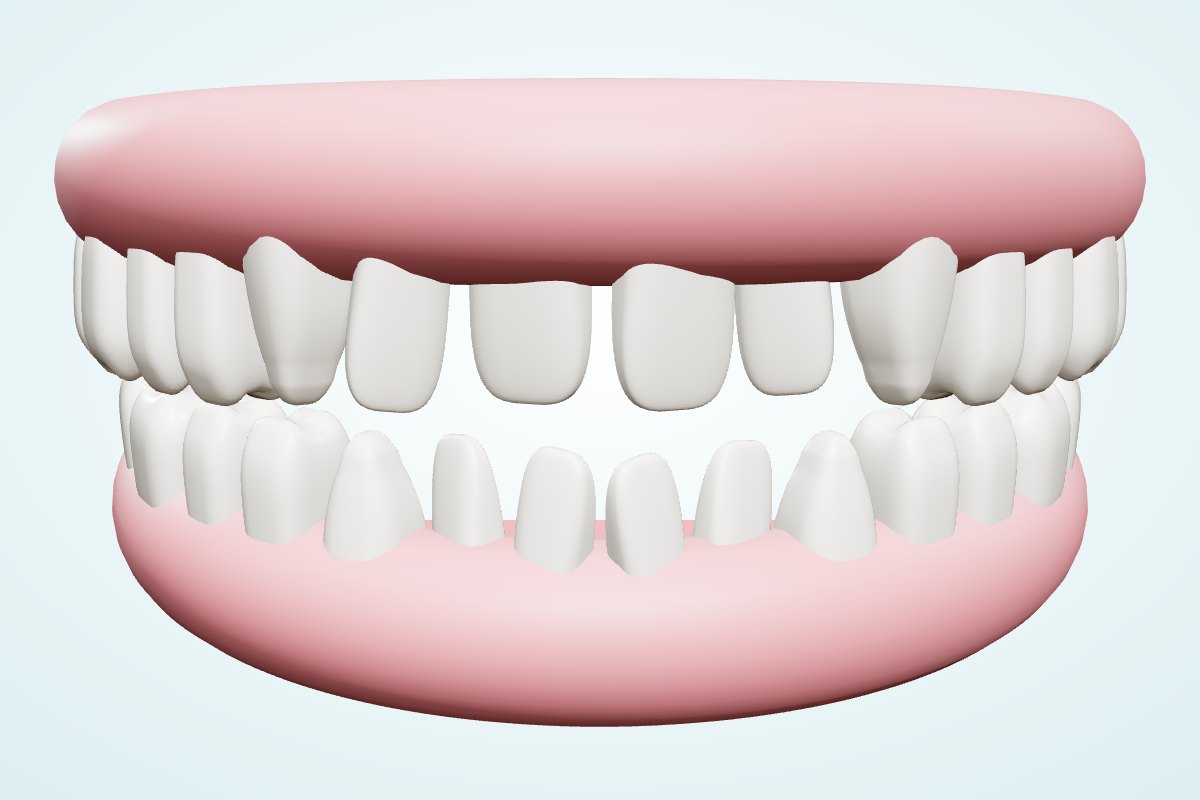
Dental crowding (teeth that do not fit in the space available in the jawbone and therefore overlap, rotate or shift forward and backward) can be corrected with clear aligners in most patients. Mild and moderate crowding is the most common and most predictable application of clear aligner treatment. The aligners push the teeth in steps of a tenth of a millimeter, in the order planned on the computer; if space is needed, very fine reduction between the teeth (IPR) is done. In severe crowding, in cases requiring extraction or when a narrow jaw is also present, aligners alone may not be enough. In these situations, braces, an expansion appliance or combined treatment options are evaluated at the consultation.
What is dental crowding, and how can you tell?
Crowding results from a mismatch between the total width of the teeth and the space the jawbone provides. Because the teeth do not fit, they slip in front of or behind each other, rotate or sit higher than the gum line. In orthodontics, this mismatch is measured in millimeters and is usually defined at three levels:
- Mild crowding: About 1–3 mm of space shortage. One or two teeth show slight rotation or overlap.
- Moderate crowding: About 4–6 mm of space shortage. Several teeth clearly overlap.
- Severe crowding: 7 mm or more of space shortage. Teeth may be completely out of line, and the likelihood of extraction increases.
At home, in front of a mirror, you may notice that your lower front teeth overlap, that one tooth sits further back than the others, or that floss is hard to pass through some gaps. The exact level is determined in the clinic with an intraoral scan or impression, a panoramic X-ray and, if needed, a cephalometric (lateral skull) X-ray.
What causes crowded teeth?
Crowding cannot be attributed to a single cause; usually several factors are present together:
- Genetics: A small jawbone combined with large teeth in the same person is the most common cause.
- Early loss of baby teeth: Neighboring teeth drift into the gap, leaving no room for the permanent tooth.
- Late-erupting or impacted teeth: Wisdom teeth and canines in particular can create pressure in the arch.
- Habits: Long-term thumb sucking, pacifier use and mouth breathing affect jaw development.
- Age-related change: In adults, increasing crowding of the lower front teeth over time is common; it also recurs in people who had orthodontic treatment when retention is neglected.
How do clear aligners correct crowded teeth?
Clear aligner treatment is a step-by-step system in which each aligner completes a small movement until the teeth reach their planned final position. With crowding, the goal is first to create space for the teeth and then to place them into that space. The main mechanisms used are:
Ways to create space
- IPR (interproximal reduction): A controlled thinning of 0.2–0.5 mm is made in the enamel between the teeth. In total it can gain a few millimeters of space and is considered not to harm tooth health.
- Arch expansion: The side teeth are tipped slightly outward to widen the arch. This provides a limited amount of space.
- Moving the front teeth forward (proclination): If the front teeth are tipped slightly forward, the arch lengthens and space is gained; this is chosen when the lip profile allows it.
- Moving the back teeth backward (distalization): Space is gained by moving the molars backward, especially in the upper jaw; elastic support is usually needed.
- Extraction: If the space shortage is large, a premolar may be extracted. Closing extraction spaces with clear aligners is possible, but planning is more complex.
Moving the teeth into place
- Attachments: These are small tooth-colored composite bumps bonded to the surface of the teeth. They help the aligner grip the tooth better; they are needed to turn rotated teeth and to move a tooth up or down.
- Step-by-step movement: Each aligner pushes a tooth by up to 0.25 mm or rotates it by a few degrees. Aligners are changed every 7–14 days according to the orthodontist's plan.
- Elastics: If there is a bite problem along with crowding, small rubber bands attached to the aligners also help correct the jaw relationship.
For which types of crowding may clear aligners fall short?
Aligners do well at sliding teeth side by side and at mild rotation; however, some movements are difficult for aligners. In the following situations, your orthodontist may recommend braces, combined treatment or an additional appliance:
- Severely rotated round teeth: Rotation of premolars and canines by more than 30 degrees is hard to control with aligners.
- Teeth sitting above the gum line: Pulling a tooth down (extrusion) is one of the weakest movements for aligners; attachments and sometimes braces are needed.
- Extraction cases: When closing large spaces, maintaining root parallelism is difficult; short-term braces or auxiliary parts may be used.
- Impacted canines: The tooth must first be surgically exposed and is usually brought into line with braces.
- Narrow upper jaw: A rapid maxillary expansion appliance may be considered, especially in children, and surgically assisted expansion in adults.
None of these situations rules out aligners completely; a common approach is to complete the difficult movement with short-term braces and continue the rest of the treatment with aligners. Which route is appropriate is decided after the examination and digital planning. You can compare the other options on the clear aligners or braces page.
How long does clear aligner treatment take for crowded teeth?
The duration depends on the amount of space shortage, how many teeth need to move and wearing the aligners consistently 20–22 hours a day. The general ranges are:
- Mild crowding: About 6–9 months.
- Moderate crowding: About 9–15 months.
- Severe crowding or crowding with extraction: 15–24 months; combined treatment may be needed.
Check-ups are usually every 6–10 weeks. The duration calculated in the planning software is an estimate; if the wearing time is not followed or some teeth move more slowly than expected, an additional set of aligners (refinement set) may be needed. For details, see the treatment duration page.
Is there a difference between children and adults?
In children and teenagers, jaw growth is still ongoing, so there are more options for creating space. In a growing patient, a narrow jaw can be widened and space can be kept for erupting teeth. There are special aligner systems designed for the mixed dentition stage (when baby and permanent teeth are present together); however, wearing compliance should be monitored together with the family. In adults, growth is complete, so space is gained through IPR, distalization or extraction. Tooth movement is somewhat slower, and gum and bone health are assessed beforehand. If there is wear or gum recession that has developed over the years along with crowding, the treatment plan is adjusted accordingly. For details by age, see the at what age clear aligners page.
Does crowding come back after treatment?
Teeth, especially the lower front teeth, tend to return to their former positions after treatment ends. For this reason, retention is an integral part of treatment. Two methods are used together or separately:
- Fixed retainer: A thin wire bonded to the back surface of the front teeth. It is invisible and often chosen for lower crowding.
- Removable retainer: Thin appliances similar to clear aligners. They are worn for long hours in the first months, then only at night; the general recommendation is nighttime wear for life.
Neglecting retention is the most common reason crowding develops again years later. You can find the topic in detail on the retainer after treatment page. For suitability criteria for aligner treatment, see the who are clear aligners for page.