

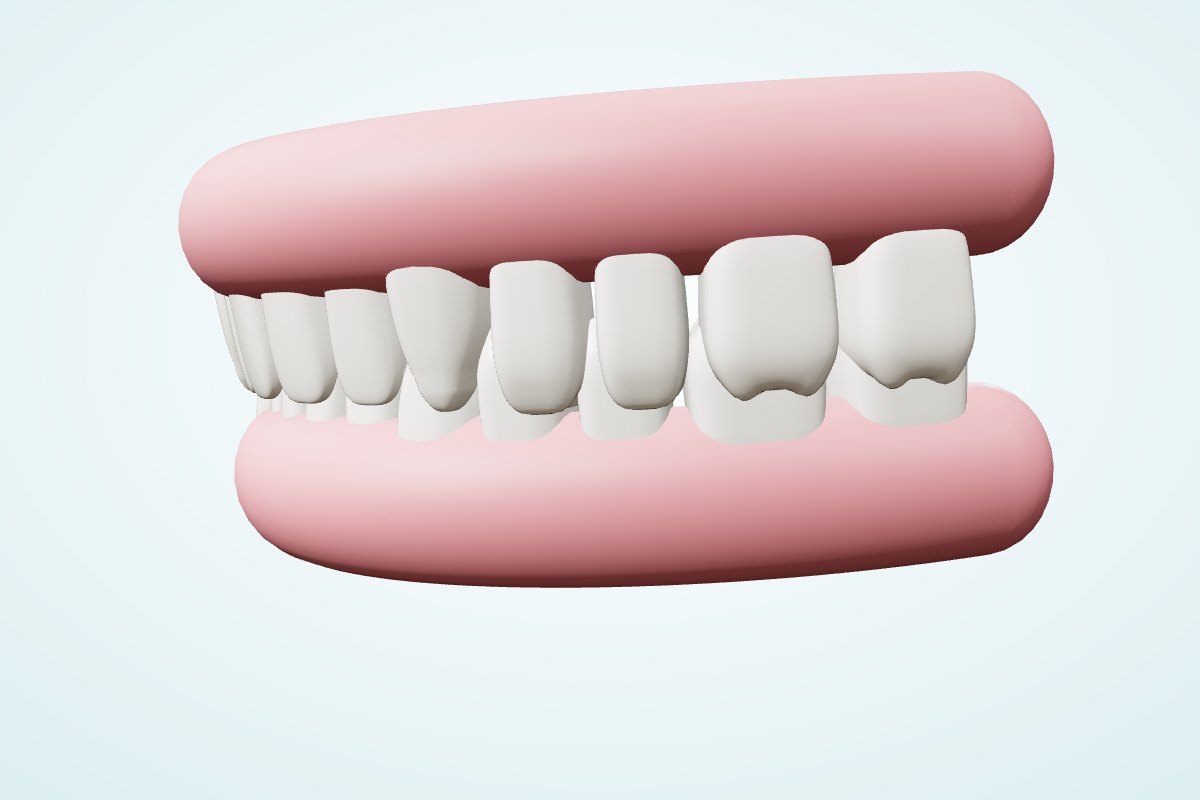
A deep bite (the upper front teeth covering the lower front teeth more than normal, usually by more than half) can be corrected with clear aligners in most patients when it is mild to moderate. The aligners gently push the front teeth into the jawbone (intrusion), allow the back teeth to lengthen slightly, and small bite ramps on the inner surface of the upper aligner help the lower front teeth open the bite. In a normal bite, the upper front teeth overlap the lower ones by 2–3 mm; in a deep bite this exceeds 4–5 mm, and sometimes the lower teeth touch the palate and the upper teeth touch the lower gums. If the deep bite comes from the jawbone (skeletal) or the front teeth need a very large amount of intrusion, aligners alone may not be enough; braces, functional appliances during growth and surgery in adults are evaluated at the consultation.
What is a deep bite, and how can you tell?
When the teeth are closed, the vertical amount by which the upper front teeth cover the lower front teeth is called overbite (vertical overlap). When this exceeds 30% of the height of the lower tooth, it is defined as a deep bite. In severe cases, the lower front teeth can touch the palatal tissue behind the upper teeth. Signs include:
- The lower front teeth are barely visible when smiling.
- Tenderness, redness or recession of the gums behind the upper front teeth (trauma from the lower teeth).
- Wear on the biting edges of the lower front teeth.
- Fatigue in the jaw joint, tension in the jaw muscles or stiffness in the morning.
- A short, deep-looking lower face with a marked groove below the lower lip.
In the clinic, the amount of vertical overlap is measured; a lateral skull X-ray (cephalometric radiograph) is used to assess the angles of the jawbones and the inclination of the front teeth. A deep bite frequently occurs together with protruding teeth (increased overjet); in that case the two problems are planned together. You can find related information on the protruding teeth page.
What causes a deep bite?
- Inherited jaw structure: A short or set-back lower jaw and a flat, horizontally developed bite plane (low-angle skeletal pattern).
- Over-eruption of the front teeth: When the front teeth do not meet and stop each other, they grow too long.
- Under-eruption or loss of the back teeth: If molars are missing or worn, the bite deepens.
- Strong chewing muscles: The muscles press the back teeth into the bone, reducing vertical height.
- Clenching and grinding (bruxism): Wear on the teeth over the years lowers the bite height.
- Relapse after previous orthodontic treatment: When retention is neglected, deep bite is one of the most commonly recurring problems.
How do clear aligners correct a deep bite?
Opening a deep bite requires shortening the front teeth or lengthening the back teeth; usually both are planned together. The mechanisms used in aligner systems are:
Intrusion of the front teeth
The aligner gradually pushes the front teeth toward the jawbone. This is a movement of moderate difficulty for aligners; to achieve it, attachments (tooth-colored composite bumps) are placed on the front and side teeth. The attachments on the side teeth act as anchorage, allowing the aligner to apply pressure to the front teeth without lifting off.
Bite ramps
Small plastic bumps (bite ramps) are added to the part of the upper aligner that sits behind the front teeth. When the lower front teeth touch the ramp, the back teeth separate; this guides the back teeth to lengthen and the front teeth to intrude. This feature can be added in the planning software of many aligner systems.
Extrusion of the back teeth
Separating the back teeth allows them to erupt in a controlled way, increasing bite height. This movement is supported with attachments. It is kept limited in patients whose facial height is already long.
Tipping the front teeth forward
Tipping backward-leaning upper front teeth forward (especially in the type called Class II division 2) opens the bite to some extent on its own. Aligners can perform this movement predictably.
Which deep bites are clear aligners not enough for?
- Cases requiring a large amount of intrusion: If the front teeth need to be intruded by more than 3–4 mm, the success of aligners alone decreases. Braces, a special intrusion arch or mini-screw (temporary anchorage device) support may be needed.
- Skeletal deep bite: If the lower jaw is short and set back, tooth movement alone does not correct facial appearance or joint load. During growth, functional appliances that guide the lower jaw forward may be planned; in adults, orthodontics together with orthognathic surgery.
- Marked wear and short teeth: In worn teeth, bite height is also addressed with prosthetic restorations (crowns, veneers), not only with orthodontics; orthodontics and prosthetics are planned together.
- Gum trauma: If the lower teeth are damaging the palate and the upper teeth the gums, the orthodontist may first prefer faster bite-opening methods (short-term braces, fixed bite blocks).
- Jaw joint problems: If there is marked joint pain or locking, a joint evaluation is done first.
You can find the roles of braces and aligners in deep bite on the clear aligners or braces page, and the skeletal limits on the can aligners correct jaw structure page.
How long does clear aligner treatment take for a deep bite?
Because vertical movements progress more slowly than horizontal ones, deep bite treatment can take somewhat longer than an average aligner treatment:
- Mild deep bite (overlap 4–5 mm): About 9–12 months.
- Moderate deep bite (overlap 5–7 mm, with crowding): About 12–20 months.
- Severe cases or cases with a skeletal component: 18–24 months or more; additional methods determine the duration.
Wearing the aligners 20–22 hours a day, proper contact on the bite ramps and regular use of elastics, if any, affect the duration. Some patients need an additional set of aligners after the first set to fully settle the bite. For general information, see the treatment duration page.
Is deep bite treatment different in children and adults?
In children and teenagers, growth is ongoing, so the eruption of the back teeth naturally helps open the bite and treatment is more predictable. If the lower jaw is set back, functional appliances or special aligner systems that bring the lower jaw forward can be used during the growth spurt between ages 10 and 13. Treatment at this stage can reduce the need for surgery in adulthood. In adults, growth is complete, so the bite is opened only by tooth movement; intrusion is somewhat slower, and bone and gum health are assessed beforehand. Wear, clenching and jaw joint complaints that have developed over the years are included in the plan. In adults who have both a deep bite and gum recession, periodontal (gum) monitoring accompanies treatment. For information by age, see the at what age clear aligners page.
Does a deep bite come back after treatment?
Deep bite is one of the problems with a high tendency to relapse; intruded front teeth tend to lengthen again and extruded back teeth tend to sink again. For retention:
- Removable retainer: A clear retainer covering the back teeth helps maintain bite height. Bite ramps can be added to some retainers. It is worn for long hours in the first months, then at night for life.
- Fixed retainer: A thin wire bonded behind the front teeth maintains their alignment; however, in a deep bite it is placed carefully so that the lower teeth do not hit the upper wire.
- Managing clenching: If there is bruxism, a night guard may be recommended; the retainer can partly take on this role.
- Regular check-ups: The amount of vertical overlap is monitored for the first two years.
For the retention process, read the retainer after treatment page, and for general criteria for aligner suitability, the who are clear aligners for page.