

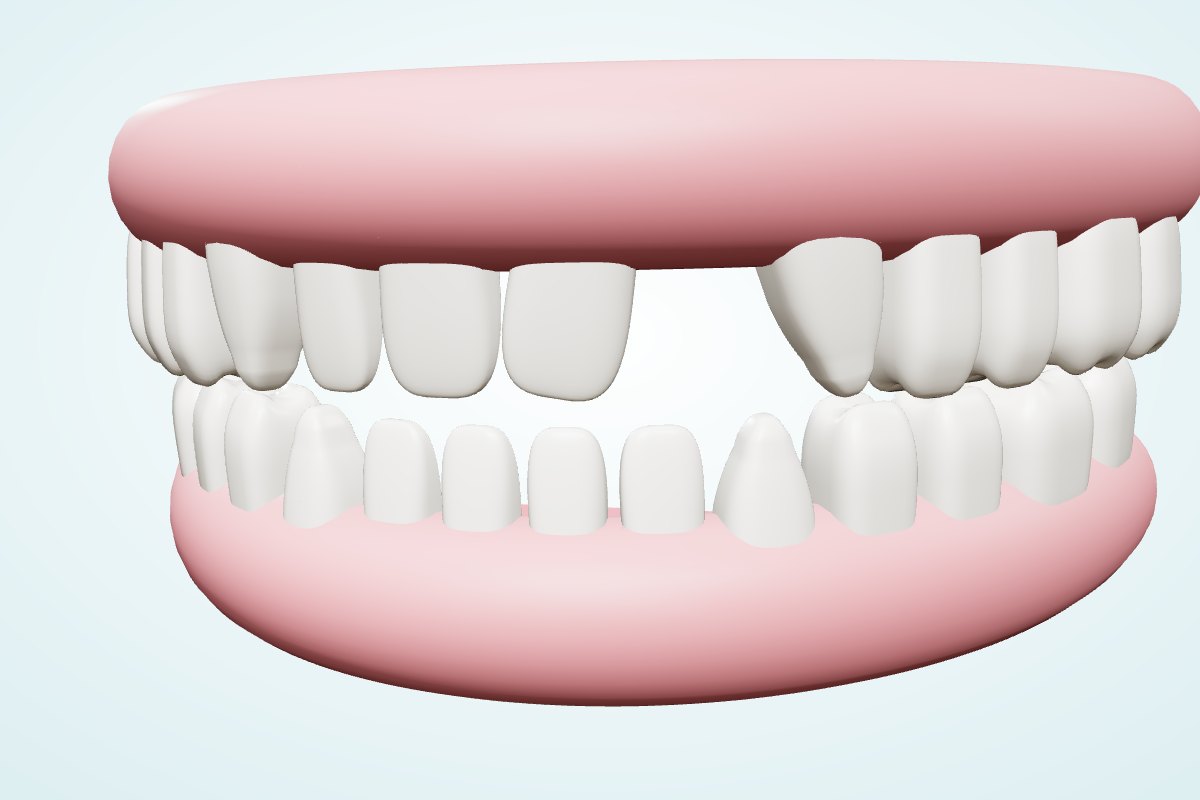
Clear aligners can be used when you have missing teeth; in fact, for patients with missing teeth, aligner treatment is often a preparatory step that needs to be carried out before an implant or prosthesis. After a tooth is extracted, or once it is found never to have developed, the neighboring teeth tip into the gap, the opposing tooth in the other jaw overerupts toward the gap and the bite is disrupted. In this situation, aligner treatment serves one of two purposes: closing the gap by moving the neighboring teeth, or uprighting the tipped teeth to create space of the right width and height for an implant or bridge. If there is already an implant in the mouth, the aligner cannot move it; the implant acts as a fixed reference point, and the teeth around it move. If there is a bridge, the teeth that support it remain a single unit, and planning is done accordingly. The usual treatment order is aligners first, followed by the implant. Which approach is suitable is determined at the examination based on the location and width of the gap, the amount of bone and age.
Why does a missing tooth cause orthodontic problems?
Teeth stay in balance with their neighbors and with the teeth in the opposing jaw. When a tooth is missing, this balance is disrupted, and over months and years the following changes develop:
- Tipping: The tooth behind the gap tilts forward and the tooth in front of it tilts backward. The gap narrows, but no properly shaped space remains for an implant.
- Overeruption of the opposing tooth (extrusion): Because it has no tooth to meet, the tooth opposite the gap grows downward or upward and interferes with the bite.
- Midline shift: A missing tooth in the front can cause the teeth to drift to one side and disrupt the symmetry of the smile.
- Bone thinning: Bone at the extraction site resorbs over time and may become insufficient for an implant.
- Chewing and joint load: A habit of chewing on one side and an imbalance in the bite may develop.
The cause of the missing tooth also affects the plan: congenital absence (most often the upper lateral incisor and the lower second premolar), extraction due to decay or fracture, loss due to gum disease, or trauma. The width of the gap, the amount of bone and the root positions of the neighboring teeth are measured with a panoramic X-ray, an intraoral scan and, if needed, a CT scan.
What options do clear aligners offer for a gap from a missing tooth?
Option 1: Closing the gap
The neighboring teeth are moved into the gap and the space is closed completely; as a result, no implant or prosthesis is needed. This approach is preferred especially when the gap is small, when there is crowding in the same jaw (the gap is used to gain space), when the patient does not want an implant or when, in a young patient, the end of growth would have to be awaited before an implant. When an upper lateral incisor is missing, the canine can be moved into the lateral incisor's place and reshaped; this option is evaluated based on the color and size of the teeth and the bite relationship. When closing a gap, the teeth need to move bodily, together with their roots, without tipping; for this, the aligners are planned with attachments (tooth-colored composite bumps) and sometimes with elastics or mini-screw support. Closing large gaps in the back of the mouth with aligners takes a long time and root control is difficult; in these cases, support with brackets may be considered.
Option 2: Creating and holding space for an implant or prosthesis
If the gap will not be closed, the aligners upright the tipped teeth (uprighting), bring the gap to the width the implant requires and push the overerupted tooth in the opposing jaw back in (intrusion). This way, the implant can be placed at the correct angle and in enough space, and the crown that will be placed on it will be in proportion to the neighboring teeth. During treatment, the gap can be filled visually with a tooth-colored filler (pontic) placed inside the aligner, so a missing front tooth does not show during treatment. In cases that also involve crowding, the gap is first partly used to gain space, and the planned width is left for the implant.
Can clear aligners be used when you already have an implant or a bridge?
With an implant: Yes, they can. Because an implant is fused to the bone, it does not move under orthodontic force; the aligner leaves it in place and moves the other teeth. In the planning software, the implant is marked as fixed. Because the implant's position limits where the other teeth can be moved, some movements cannot be planned. For this reason, whenever possible, the implant is placed after orthodontic treatment has finished. If an attachment needs to be bonded to the crown on an implant, a different bonding method is used or the attachment is moved to the neighboring tooth.
With a bridge: A bridge joins two or more teeth together as a single unit; these teeth cannot move independently of each other. The aligner can move the bridge as a whole to a limited extent, or leave it fixed and move the other teeth. If the supporting teeth of the bridge need to move separately, the bridge is temporarily cut and replaced at the end of treatment; this decision is made together with the prosthodontist. The margins of the old bridge and the health of the supporting teeth are evaluated before treatment.
With crowns and fillings: Crowned teeth can be moved; bonding attachments to a porcelain surface requires special preparation. Large fillings do not prevent aligner treatment.
What should the treatment order be: aligners first or the implant first?
The general rule is orthodontics first, then the implant, because once an implant is placed its position cannot be changed and the range of movement of the surrounding teeth narrows. A typical order is as follows:
- Assessment: The orthodontist and, if needed, the implant dentist or prosthodontist plan together; it is decided whether the gap will be closed.
- Treatment of gums and cavities: Active gum disease and cavities are brought under control before aligner treatment.
- Aligner treatment: The teeth are aligned, and the gap is closed or prepared for the implant. The gap can be temporarily filled with a pontic in the aligner.
- Retention and implant: When aligner treatment ends, the gap is held with a retainer until the implant is placed; a tooth-colored pontic can be added to the retainer. Implant surgery, bone healing (usually 2–6 months) and the restoration on top are completed during this period.
- Long-term retainer: After the implant crown is placed, the retainer is renewed to fit it.
If the amount of bone is very small, bone grafting may be planned first or, in some cases, the implant may be placed early and used as anchorage (a fixed support); these special situations are agreed on between the dentists. In young patients, the implant is postponed until jaw growth is complete (usually age 18–20 and later); during this time the gap is held with a retainer and pontic.
How long does clear aligner treatment take in cases with missing teeth?
- Creating space and uprighting for an implant: About 6–12 months; planned together with aligning the other teeth.
- Closing a small gap (front teeth, 2–4 mm): About 6–12 months.
- Closing a large gap (back teeth, molar): 18–30 months; root control and the need for mini screws lengthen the time.
- Together with crowding or a bite problem: 12–24 months.
Wearing the aligners 20–22 hours a day, consistent use of elastics and keeping up with check-ups every 6–10 weeks affect the duration. The implant process is added on top of these times. For general information, see our treatment duration and treatment process pages.
Is planning for missing teeth different in children and adults?
In children and adolescents, a missing tooth is usually congenital, and noticing it early makes planning easier. Because an implant cannot be placed while growth continues, two approaches stand out: closing the gap (for example, moving the canine into place when an upper lateral incisor is missing) or holding the gap with a retainer and pontic until growth is complete. If a baby tooth has remained in the mouth without a permanent tooth beneath it, it may be left in place if it is in suitable condition. The decision to close a gap at an early stage is made carefully, taking into account the bite and tooth sizes. In adults, a missing tooth usually comes with tipping and overeruption that have developed over the years after an extraction; reversing these changes is the main goal of treatment. If there is bone loss, a joint plan is made with the implant dentist. Gum health and teeth-clenching habits are evaluated in advance. For information by age group, see our at what age can you get clear aligners page.
How are the gap and alignment maintained after treatment?
- A gap awaiting an implant: A removable retainer is used together with a pontic that fills the gap; it is worn continuously until the implant is placed so that the gap does not narrow. In the front of the mouth, a temporary tooth attached to a fixed retainer wire is also an option.
- A closed gap: There is a tendency for it to reopen; a fixed retainer together with a removable retainer worn at night for life is recommended.
- After the implant is completed: The retainer is renewed to fit the new crown; because the implant does not move, it is important that the neighboring teeth hold their positions.
- Regular check-ups: The integrity of the implant, bridge and retainer is monitored at yearly check-ups.
For details on retention, read our retainer after treatment page; for the gap-closing method, our gaps between teeth page; and for the general criteria for aligner suitability, our who are clear aligners for page.