

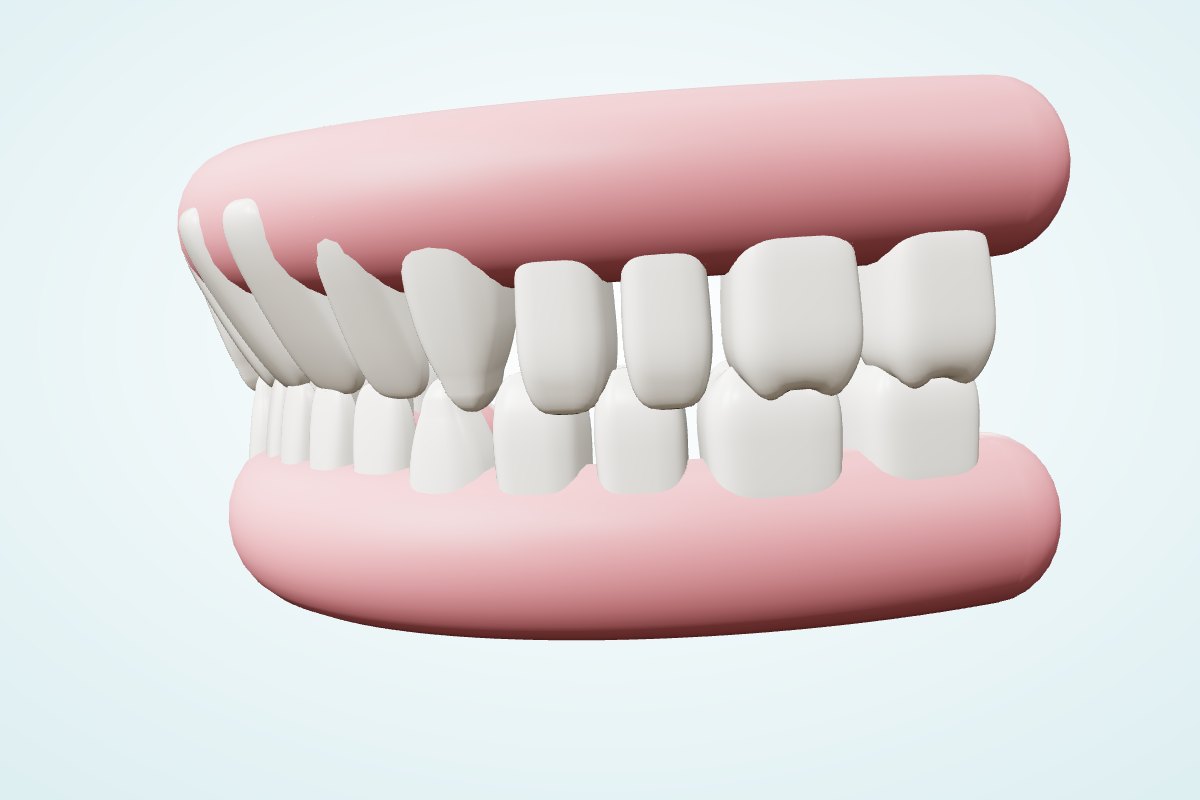
Protruding teeth (upper front teeth sitting clearly in front of the lower front teeth; called increased overjet in orthodontics) can be corrected with clear aligners in most patients when the problem comes from the tilt of the teeth. The aligners gradually move the upper front teeth backward (retraction). This requires space, which is created by interproximal reduction (IPR, fine polishing between the teeth), by moving the back teeth backward (distalization) or, if necessary, by extracting teeth. Class II elastics worn between the upper and lower aligners guide the lower jaw and lower teeth forward and the upper teeth backward. Normal overjet is 2–3 mm; above 5 mm it is considered increased. If the problem lies not only in the teeth but in the jawbones (the upper jaw positioned forward or, more often, the lower jaw set back), aligners alone cannot change the skeletal relationship. For growing children, aligner systems or functional appliances that guide the lower jaw forward are considered; for adults, camouflage treatment with extractions or orthognathic (jaw) surgery are evaluated at the consultation.
What are protruding teeth (increased overjet), and how can you tell?
Overjet is the horizontal measurement of how far the upper front teeth sit in front of the lower front teeth. Most of what people call protruding teeth, buck teeth or an overbite is in fact increased overjet. Typical signs include:
- The upper front teeth show when the lips are at rest, and closing the lips takes effort.
- The lower lip rests behind the upper teeth (lip trap), pushing the teeth even further forward.
- In profile, the upper lip looks prominent and the chin looks set back.
- The front teeth are exposed to trauma; in children, the risk of breaking a front tooth in a fall is higher.
- It frequently occurs together with a deep bite.
In the clinic, overjet is measured in millimeters. A lateral skull X-ray (cephalometric radiograph) shows the position of the upper and lower jaws relative to the skull base and the inclination of the front teeth. This reveals whether the problem is dental or skeletal and how much each component contributes. This distinction is the key step that shapes the treatment plan.
What causes protruding teeth?
- Retruded lower jaw: The most common skeletal cause of increased overjet is not a forward upper jaw but an inherited small or set-back lower jaw.
- Protruding upper jaw: Less often, the upper jawbone has grown too far forward.
- Forward-tilted front teeth: Even with a normal jaw relationship, the upper front teeth can be tipped forward (proclination); this is the dental type and the group that responds most predictably to aligner treatment.
- Thumb sucking, pacifiers, tongue thrust: Long-lasting childhood habits push the upper teeth forward and the lower teeth backward.
- Lip trap and weak lip seal: A lower lip resting behind the teeth keeps the problem going.
- Mouth breathing: It affects jaw development and contributes to the lower jaw staying behind.
- Gaps and gum disease: In adults, bone loss can cause the front teeth to fan out forward.
How do clear aligners correct protruding teeth?
The basic principle of reducing overjet with aligners is to create space for moving the upper front teeth back and then move the teeth into that space in a controlled way:
Creating space
- IPR (interproximal reduction): A few millimeters in total are gained between the upper front and side teeth; this is enough in mild cases.
- Distalization: The upper molars are moved backward one after another. Aligner systems do this by moving the teeth individually, from back to front; it is generally predictable up to 2–3 mm. Elastic support and sometimes mini-screws (temporary anchorage devices) are needed.
- Arch expansion: Moving the side teeth slightly outward provides some space.
- Extraction: If the overjet is large and the lip profile is clearly forward, upper premolars can be extracted so the front teeth can be moved back a large amount. Closing extraction spaces with aligners is possible, but strong attachments and careful planning are needed so the front teeth move back bodily without tipping.
Moving the teeth back
- Attachments: Tooth-colored composite bumps are bonded to provide root control on the front teeth and anchorage on the side teeth.
- Class II elastics: Rubber bands running from the upper canine area to the lower molar area pull the upper teeth back and the lower teeth forward; they also provide anchorage for moving the back teeth backward.
- Opening the bite: If there is an accompanying deep bite, bite ramps and intrusion of the front teeth are added to the plan; otherwise the upper teeth catch on the lower teeth and cannot move back. For details, see the deep bite page.
- Step-by-step movement: Each aligner moves the teeth 0.2–0.25 mm; aligners are changed every 7–14 days according to the orthodontist's plan.
When are clear aligners not enough on their own?
- Marked skeletal lower jaw retrusion (adults): Tooth movement reduces overjet but does not bring a set-back jaw forward; the profile does not change. If facial appearance is also to be corrected, orthodontics is planned together with orthognathic surgery. Tooth alignment before and after surgery can be done with aligners.
- Large overjet (8 mm or more): Usually requires extraction treatment or mini-screw-supported distalization; braces may be preferred for some phases.
- Extraction spaces requiring root parallelism: If the risk of the front teeth tipping is high, short-term braces or combined treatment may be used.
- Ongoing habits: If thumb sucking, tongue thrust or lip trap are not addressed, the result will not be stable; habit-breaking approaches and lip exercises are added.
- Flaring due to gum disease: Periodontal treatment is completed first.
You can read about the limits of aligners on the jawbone on the can aligners correct jaw structure page, and a comparison with braces on the clear aligners or braces page.
How long does clear aligner treatment take for protruding teeth?
- Mild dental overjet (4–5 mm), with IPR: About 9–12 months.
- Moderate overjet requiring distalization and elastics: About 14–20 months.
- Extraction or mini-screw-supported cases: 18–24 months.
- Aligner systems that bring the lower jaw forward during growth: First a 6–12 month jaw-guidance phase, then 10–14 months for tooth alignment.
- Surgical cases: 18–30 months in total; the surgery schedule is decisive.
Wearing the aligners 20–22 hours a day and using the elastics for the time set by the orthodontist directly determine the duration, especially in distalization cases. For general information, see the treatment duration page.
Is treatment for protruding teeth different in children and adults?
In children and teenagers, treatment of protruding teeth takes advantage of growth. If the lower jaw is set back, functional appliances that guide the lower jaw forward during the growth spurt between ages 10 and 14, or clear aligner systems with wings (mandibular advancement feature) that do the same job, can be used. In these systems, plastic wings on the sides of the upper and lower aligners position the lower jaw forward when the mouth closes, guiding jaw growth while also aligning the teeth. Front teeth that stick out a lot at an early age also matter because of the risk of breaking in a fall; for some children, short early treatment at age 8–10 may be recommended. In adults, jaw growth is complete, so there are two paths: camouflage treatment that compensates for overjet by moving the teeth (IPR, distalization, extraction if needed) or surgery that corrects the skeletal problem. In mild and moderate cases, camouflage often gives a satisfactory result; for patients with high profile expectations and a marked lower jaw retrusion, the surgical option is discussed. For information by age group, see the at what age clear aligners page.
Do protruding teeth come back after treatment?
Front teeth that have been moved back may tend to come forward again if the balance of lip and tongue pressure has not changed. To keep the result stable:
- Fixed retainer: A thin wire bonded to the back of the upper and lower front teeth prevents them from fanning forward; in extraction cases it stops the space from reopening.
- Removable retainer: A clear retainer is worn for long hours in the first months, then at night for life. If a deep bite was also corrected, a retainer covering the back teeth is preferred.
- Lip and tongue habits: Simple exercises for lip trap and tongue thrust reduce relapse.
- Regular check-ups: Overjet is monitored for the first two years, and the integrity of the fixed wire is checked.
For details on retention, read the retainer after treatment page, and for general criteria for aligner suitability, the who are clear aligners for page.