

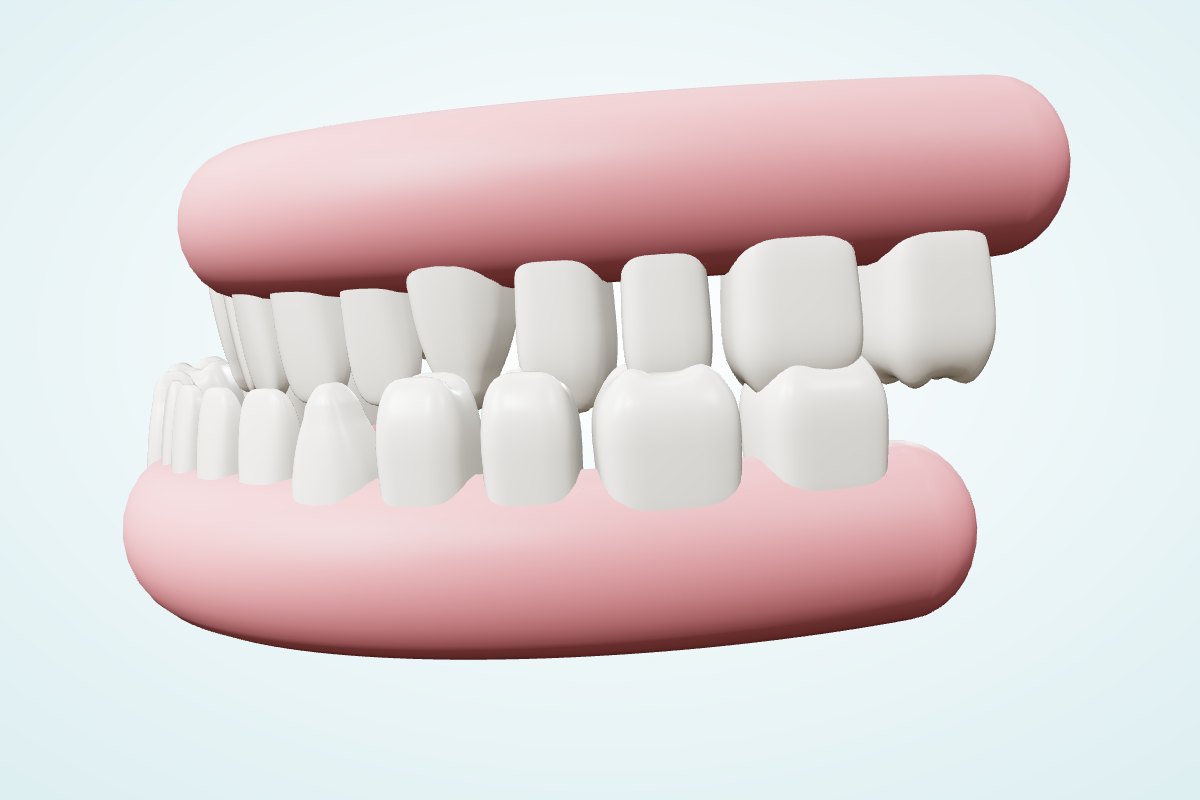
A crossbite (one or more lower teeth closing in front of or outside the upper teeth, the reverse of how they should meet) can be corrected with clear aligners in most patients when it is caused by the position of the teeth. The aligners gradually tip the affected teeth to the correct side; if needed, they widen the dental arch slightly, and cross elastics worn between the upper and lower aligners help the bite settle. A single front tooth in reverse bite and a mild posterior crossbite are problems that aligners resolve predictably. However, if the crossbite is caused by a narrow upper jaw or a forward lower jaw (skeletal crossbite), aligners alone cannot change the skeletal relationship. During growth, an upper jaw expansion appliance may be considered; in adults, surgically assisted expansion or orthognathic (jaw) surgery may be needed. The type is determined by clinical examination, model analysis and X-rays.
What is a crossbite, and how can you tell?
In a normal bite, the upper teeth slightly overlap the lower teeth from the outside, both at the front and at the sides. In a crossbite, this relationship is reversed for at least one tooth. There are two main types:
- Anterior crossbite: One or more upper front teeth close behind the lower front teeth. If all the front teeth close in reverse, an evaluation for a forward lower jaw (Class III) is needed.
- Posterior crossbite: The upper molars or premolars sit inside the lower teeth. It can be one-sided or two-sided. In the one-sided type, the lower jaw often shifts to one side when closing (functional shift).
Signs include noticing that the jaw shifts to one side when closing, mild facial asymmetry, chewing on one side only, wear and gum recession on the affected teeth, and clicking or pain in the jaw joint. In the clinic, the bite relationship of the teeth is examined and the resting and closing positions of the lower jaw are compared; the width of the upper jaw is measured on a digital model. If needed, frontal and lateral X-rays or three-dimensional CT scans are used to assess skeletal narrowness.
What causes a crossbite?
- Narrow upper jaw: Because of genetics, or as a result of mouth breathing, long-term thumb sucking and pacifier use, the upper jaw does not widen enough. This is the most common cause of posterior crossbite.
- Teeth erupting in the wrong position: A baby tooth that falls out late can push the permanent tooth inward or outward. This is a common cause of single-tooth anterior crossbite.
- Forward lower jaw: An inherited large or forward lower jaw causes all the front teeth to close in reverse.
- Retruded upper jaw: An upper jaw that has not grown forward enough can also cause an anterior crossbite.
- Crowding: Teeth pushed out of line by lack of space can end up in crossbite.
- Tooth loss and drifting: In adults, neighboring teeth tip into the gap left by extracted teeth.
How do clear aligners correct a crossbite?
The goal of treating a crossbite with aligners is to move the tooth in reverse bite to the correct side and to overcome the teeth catching on each other during closing. The mechanisms used are:
Tipping the teeth
In an anterior crossbite, the plan is to tip the upper tooth that sits behind forward and, if needed, the opposing lower tooth backward. This is one of the most predictable movements for aligners. An attachment (a small tooth-colored composite bump) is added for root control of the tooth.
Widening the dental arch (dentoalveolar expansion)
In a posterior crossbite, the upper side teeth are tipped outward to widen the arch. The expansion aligners can achieve is limited; the teeth must remain within the bone. The amount of expansion is set according to the gum and bone thickness, and excessive expansion can cause gum recession.
Cross elastics
For teeth in reverse bite, small rubber bands attached from the outer surface of the upper tooth to the inner surface of the lower tooth (or vice versa) pull the teeth toward the correct side against each other. The elastics are hooked onto cut-outs in the aligner or onto small buttons on the teeth.
Temporarily opening the bite
A tooth in reverse bite cannot move because it catches on the opposing tooth. The thickness of the aligner or bite blocks temporarily opens the bite by a few millimeters, so the tooth can move freely. This feature of aligners may make the separate bite-raising step used in treatment with braces unnecessary.
When are clear aligners not enough on their own?
- Skeletally narrow upper jaw: If the narrowness is at the bone level, tipping the teeth outward is not the solution; the risk of gum recession and relapse increases. During growth (usually up to age 14–15), a rapid maxillary expansion appliance that opens the midpalatal suture is used. After growth is complete, mini-screw-assisted expansion (MARPE) or surgically assisted expansion (SARPE) are options. The remaining tooth alignment after expansion can be completed with aligners.
- Forward lower jaw (Class III): If all the front teeth close in reverse and the lower jaw is clearly forward, tooth movement does not correct facial appearance. During growth, a face mask and intraoral appliances are planned; in adults, orthodontics is planned together with orthognathic surgery. In mild cases, camouflage with aligners (compensating for the bite by moving the teeth) may be suitable.
- Marked functional shift: If the lower jaw shifts a lot when closing, the true jaw position is determined first and the plan is made accordingly.
- Severely tilted or deeply positioned teeth: If a large amount of root movement is needed, short-term braces or combined treatment may be preferred.
- Jaw joint complaints: If there is pain or locking, a joint evaluation comes before orthodontics.
You can find more about the limits of aligners on the jawbone on the can aligners correct jaw structure page, and about crossbite occurring with lack of space on the crowded teeth page.
How long does clear aligner treatment take for a crossbite?
- Single-tooth anterior crossbite: About 4–8 months; it is usually planned together with aligning the other teeth.
- Mild posterior crossbite (dental): About 8–14 months.
- Cases with crowding that require elastics: 12–18 months.
- Skeletal cases requiring an expansion appliance or surgery: 4–6 months with the appliance, followed by 12 months or more with aligners; 18–30 months in total for surgical cases.
Wearing the aligners 20–22 hours a day, using the cross elastics regularly and attending check-ups every 6–10 weeks determine the duration. For general information, see the treatment duration page.
Is crossbite treatment different in children and adults?
In children, crossbite is one of the problems for which early intervention is most often recommended. In a one-sided posterior crossbite, if the jaw constantly shifts to one side when closing, expansion treatment between ages 7 and 10 is considered because of the risk of the face developing asymmetrically. At this age the midpalatal suture has not yet fused, so expansion appliances are very effective. A single tooth in reverse bite is also corrected early; otherwise wear and gum recession can develop on the tooth. Aligner systems designed for the mixed dentition stage can be used in mild cases. In adults, the midpalatal suture has fused, so bone expansion is only possible with mini-screw or surgical support. A dental crossbite, however, can be corrected with aligners at any age; gum health, bone thickness and joint condition are assessed beforehand. For information by age group, see the at what age clear aligners page.
Does a crossbite come back after treatment?
Once a crossbite is corrected, the teeth lock into the correct bite, so relapse is less common than with some other problems; however, an expanded arch tends to narrow. For retention:
- Removable retainer: A clear retainer or an acrylic retainer that also covers the palate maintains the arch width. It is recommended to wear it for long hours in the first months and then at night for life.
- Fixed retainer: A thin wire bonded behind the front teeth maintains their position if an anterior crossbite was corrected.
- Controlling habits: If mouth breathing and tongue position problems continue, an ear, nose and throat (ENT) evaluation and myofunctional exercises reduce relapse.
- Regular check-ups: In cases with expansion, arch width is monitored for the first two years.
For details on retention, read the retainer after treatment page, and for general criteria for aligner suitability, the who are clear aligners for page.